






The first time I went out to Skellig Michael, I spent the entire boat ride gripping the side and wondering what I'd got myself into. The Atlantic was lumpy, the spray was constant, and my camera gear was getting a saltwater baptism in the bottom of the boat. As we approached the island, the first thing that hits you is the eastern steps - they rise almost vertically from just above the pier, ancient and vertiginous, and completely impossible to miss. For a few horrible seconds I thought those were the steps I'd have to climb. The relief when I learned they wasn't accessible was short-lived - the south steps, which are the actual route, turned out to be only marginally less terrifying.
I've made that crossing more times than I can count since then, in all conditions and all seasons, and every trip has taught me something. This is the practical guide I wish someone had given me before that first one - it covers the boats, the booking, the climb, and what to do if the weather doesn't cooperate. Which, this being the Atlantic coast of Ireland, is more likely than you'd hope.

When Can You Visit?
The landing season runs from mid-May to the end of September, though the exact dates are set by the OPW each year and can shift slightly. Outside of these months, the island is closed to visitors entirely - the steps aren't maintained through the winter, and the sea conditions make regular landings impractical.
The best months for a visit are June, July, and August. June offers the longest daylight hours and the puffins are at their most active. July and August are the busiest - book as far ahead as you possibly can for these months. September is quieter, the light is arguably better for photography, but you're more exposed to autumn weather and cancellations.
Booking a Boat
As of 2026, there are about 15 boats licensed by the OPW to carry landing tour passengers - the exact number can vary from year to year as licences are reviewed. Each boat takes a maximum of 12 people, which means roughly 180 visitors can land on the island per day. Most boats depart from Portmagee, with a couple operating from Ballinskelligs and Derrynane.
Book as early as you can. I'd recommend contacting operators in January or February for a July or August visit - the most popular dates fill up months in advance. The main operators include Skellig Michael Cruises, Casey's, Skellig Coast Adventures, and Pat Joe Murphy's boats, among others. A quick search will bring up the full list of licensed operators.
The boatmen from Portmagee come across the bridge to Valentia every morning during the season to look at the way the sea is breaking on the islands and nearer landmarks. That's how they judge whether to venture out or stay in the safety of Portmagee Harbour. I've watched them do this for years - a quiet ritual of experience reading the water that no weather app can replicate. It's not a decision they take lightly, and it's worth remembering that the income from Skellig trips is highly variable for the operators - they're entirely at the mercy of the weather, so a cancelled day is a lost day's earnings for them too.
If you couldn't get a booking in advance, don't give up. There are often cancellations on the day, so it's worth showing up at the marina early - around 8:30am - and asking around. People cancel for all sorts of reasons, and the operators would rather fill the seat than leave it empty.
What to Expect on the Crossing
The boat trip takes about 45 minutes to an hour each way. On a calm day it's a pleasant cruise with great views of the Kerry coast, and you'll likely spot dolphins, seals, and possibly basking sharks along the way. On a rougher day, it's a very different experience. The Atlantic doesn't do subtlety.
If you're prone to seasickness, come prepared. Take medication well before you board, not once you're already feeling green. Sit near the back of the boat where the motion is less pronounced, and keep your eyes on the horizon. The crews are very experienced and they'll tell you where to sit if you ask.
As of 2026, the average landing success rate is about 65%. Roughly one in three booked trips gets cancelled due to weather. Don't plan your entire holiday around getting to land - the persistence required is part of the experience, but build in a contingency day or two if you can. I've seen people rearrange entire itineraries for a second chance at a clear morning, and it's almost always worth it.
Landing and Getting Ashore
The approach to the island is straight in to the pier at Blind Man's Cove - the modern landing point, built during the lighthouse construction in the 1820s. The eastern steps dominate the view as you come in, rising from just above the pier in a near-vertical line up the cliff face. They're dramatic and ancient, but don't worry - their base was blasted away during the lighthouse construction, so they're not accessible. Your route is the south steps, which begin at the end of the Lighthouse Road. Only marginally less dramatic.
The crews are experienced and helpful - they've been doing this for decades and they're very good at getting people safely on and off the boats. Listen to their instructions, watch your footing, and you'll be fine. Once ashore, you'll have roughly two and a half hours on the island before the boat returns to collect you. That's enough time to climb to the monastery and back with time to spare - but don't dawdle too much at the bottom or you'll feel rushed at the top.
The Climb
From the pier, the Lighthouse Road runs along the southern side of the island to the base of the south steps. It's an easy, relatively flat walk with spectacular views out over the water. The OPW has been working on restoring sections of this road and the lighthouse buildings, and there are plans to open more of this area to visitors as an alternative to the full climb - giving people the chance to experience the island without the ordeal of the steps. For now, the Lighthouse Road takes you to the base of the south steps and Cross Cove, where the puffins congregate in summer.

For those who do make the climb, it's 618 uneven medieval steps to the monastery. The steps are original - hand-cut into the rock by the monks themselves over a thousand years ago. Good footwear is essential here - no flip-flops, no heels, no smooth-soled anything. The steps are steep in places, they can be slippery when wet, and there are no handrails on much of the route.
Early on, there's a section where you cross a narrow rock ledge with a vertical wall above you and a drop of a few metres below. There's a safety chain attached to the wall. If you can manage that section without feeling the need to grip the chain, you're probably fine for the rest. If you're clinging to it for dear life - take note, because there are much more exposed sections higher up with no safety rail at all.
The steepest section is immediately below Christ's Saddle - the valley between the island's two peaks. Going up is grand, but coming down you're walking straight down a very steep slope with nothing in front of you. No handrails. It's not uncommon to see people scooting down on their backsides, one step at a time. No shame in that at all!
At Christ's Saddle, take a breather and look around. Directly ahead of you as you arrive are the north steps, plunging down into Blue Cove - dramatic, but off-limits to visitors. To the left you'll see the start of the climb to the South Peak, where the hermitage terraces are - you'd need a permit to attempt that. To the right are the final steps up to the monastery. This last section is steep at first, but then flattens out to a lovely sheltered walk for the last hundred metres or so. I've been on the island many times in high wind, where people had to climb on their hands and knees. But once you reach the enclosure, the wind drops away to a gentle breeze due to the shelter offered by the peak itself. Worth every step!
OPW guides are stationed at the base of the steps and at the monastery itself - they're excellent at explaining the history. You're on your own on the steps themselves, though, so take your time and watch your footing.
At the Top
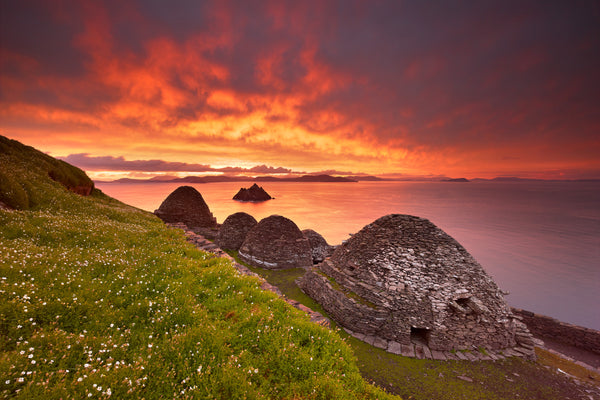
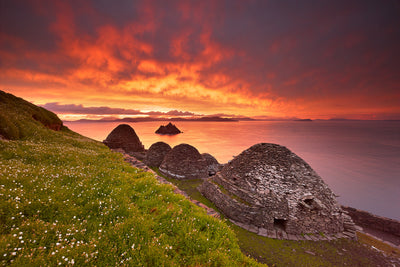
When you step through the entrance to the monastery, the scale of what the monks built hits you. The enclosure holds six intact beehive cells, a larger oratory, a small oratory, and a graveyard marked with stone crosses. The cells are remarkably intact, dry inside even after centuries of Atlantic weather - built without a single drop of mortar using a corbelling technique that sheds rainwater off each course of stone. The larger oratory is boat-shaped, with walls over a metre thick, and would have been the centre of daily monastic life.
St. Michael's Church, added later - probably around the 10th or 11th century - is in the worst repair of any of the buildings. Unlike the original drystone structures, it was built with lime mortar and imported Valentia sandstone, and that mortared construction turned out to be less resilient to the slight movement of the terrace over time. Just two walls remain today, including the gable wall with its window looking out over the Small Skellig. Inside the church is the grave of the Callaghan brothers - Patrick and William, aged two and four, sons of a lighthouse keeper who died in the winter of 1868-69. It's a sobering thing to come across in a place this remote.

The views from the monastery out over the Atlantic are extraordinary on a clear day - you can see the mainland, the Small Skellig white with gannets, and sometimes the outline of the Blasket Islands to the north. The OPW guides stationed here are worth listening to. They know the site inside out and will point out details you'd miss on your own - the channels carved into the rock for rainwater collection, the cisterns beneath the terraces, and the subtle differences between the older and newer structures.
People tend to eat their packed lunches in the entryway to the monastery, sitting on the stone walls and looking down at the Monk's Garden. A word of warning: the black-backed and herring gulls up there are piratical. They'll take the sandwich right out of your hand without so much as a thank-you. Keep your food close.
It's worth noting that the lighthouse keepers who lived on the island in the 19th century kept livestock here - cows, goats, chickens, and pigs. Christ's Saddle was about the only flat ground on the entire rock, so that's where the animals were kept. Michael Wishart, one of the very first keepers, fell to his death in 1828 while cutting grass for his cow. Another keeper, named Redmond, lost a son who fell near Blue Cove. The island has a long history of extracting a price from the people who try to live on it.
What to Bring
There are no facilities on the island. No toilets, no shelter, no shop. You're on a rock in the Atlantic, and you need to be prepared for that!
My essentials: sturdy shoes with good grip (this is non-negotiable), a waterproof jacket (the weather can change completely in an hour), layers (it can be colder than you'd expect, even in summer), water, and lunch packed in a rucksack so your hands are free for the climb. Suncream and a hat on fine days - there's no shade. A camera, of course, but keep it in a bag or around your neck where it won't get in the way on the steps.
If You Can't Land
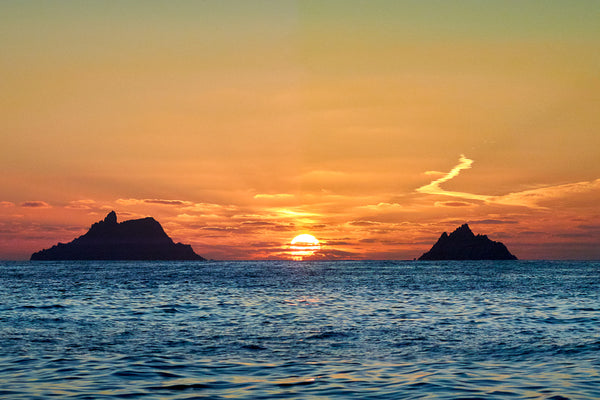
If the weather prevents a landing, most boat operators offer a cruise around both islands instead. This is genuinely worth doing - you'll get close-up views of the gannet colony on the Small Skellig, which is extraordinary in its own right, and dramatic views of Skellig Michael from the water that you'd never see from the top of the steps.
One word of caution, though: if the water's too rough to land, it's not going to be a smooth cruise either. If you tend to go green in the bathtub, you might want to think twice. The operators will usually offer a refund or reschedule as an alternative.
Where to Stay Nearby
Portmagee is the main base for Skellig trips, and there's a good range of accommodation in the village and the surrounding area. Valentia Island is just across the bridge and has several B&Bs and guesthouses with views out towards the Skelligs. Cahersiveen, Waterville, and Ballinskelligs are all within easy driving distance and offer more options.
I'd recommend staying local the night before your trip. Departure times are early - typically between 8am and 10:30am - and the operators need you at the marina 20 minutes before departure. You don't want to be rushing from a hotel an hour away.
A useful tip: some local accommodation providers have long-standing relationships with the boat operators and may have spaces set aside for their guests. It's worth asking when you book your accommodation.
Leave a comment