




I've been photographing the Skelligs for over a decade, and the body of work I've built there is probably the thing I'm most proud of. It's also the work that's been the hardest to make - not because of any technical difficulty, but because access to the island is so restricted that each opportunity has to count. You can't just go back tomorrow if the conditions weren't right.
This is the story of how I photograph the Skelligs, and some advice for anyone who wants to make the most of their own visit with a camera.

The Access Problem
The fundamental challenge of photographing Skellig Michael is that visitors are only permitted between approximately 10am and 2:30pm during the summer months. That's a window when the light is at its worst - high, flat, and harsh. The images that define these islands - the dramatic sunrises, the stormy skies, the monastery under the stars - all require access outside those hours, and that access is extremely rare.
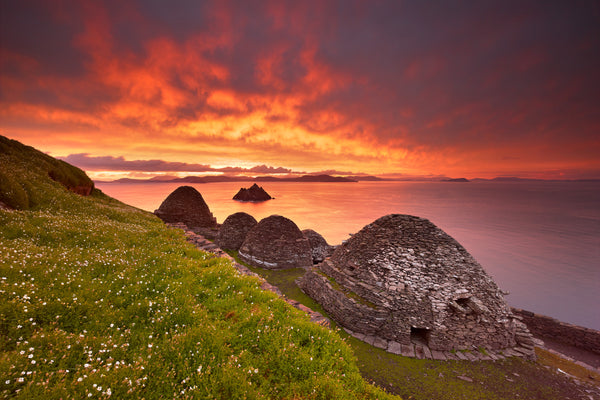
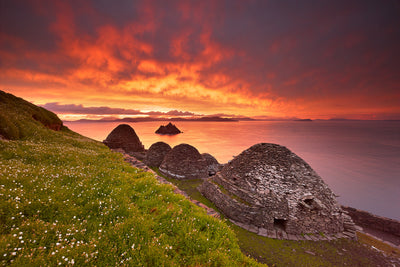
I've been fortunate enough to gain permission from both the OPW and the Commissioners of Irish Lights to spend time on the island when it's otherwise empty. Over the course of several visits, I've had the opportunity to work at sunrise, sunset, and through the night. Even the Star Wars production team wasn't permitted to overnight on the island, so these images really are from a vantage point that very few people have experienced.
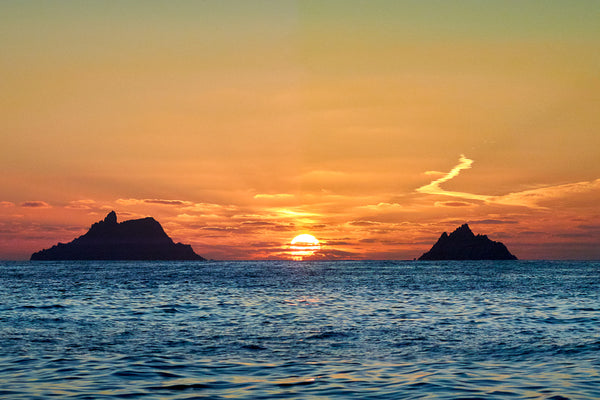
That said, you don't need special access to make compelling photographs on the Skelligs. Some of my favourite images of the islands have been made from the water, from the mainland, and from the air - none of which require setting foot on the monastery at all.
One important note: drones are expressly forbidden on and around Skellig Michael. Don't bring one.
Staying on the Island
I've spent several nights on Skellig Michael over the years. The experience of being alone on this rock after the last boat has left is difficult to describe - the silence, the scale of the sky, the sense of being in a place that hasn't fundamentally changed in a thousand years.
On one occasion, I timed the visit for a quarter moon - enough light to illuminate the foreground of the monastery, but not so bright as to drown out the stars. It's a balance you have to get right for this kind of work, and it took a lot of planning to make it happen. We went up to the South Peak that evening and came back down around sunset, and then I started working through the night.
The nocturne images were made using long exposures of 15 to 30 seconds. I used a dimmed camping light to add a little warmth to the inside of the beehive structures in some compositions. Under quarter-moonlight you can actually see surprisingly well - the eye adjusts, and the monastery takes on a quality that's very different from daylight. The Iveragh peninsula is home to the Kerry International Dark Sky Reserve - the first Gold Tier reserve in the Northern Hemisphere, and one of only four in the world - and being out there under those skies, seeing very much what the monks would have seen a thousand years ago, was quite something. The residual light pollution at the horizon and the few house lights visible on the mainland were the only things different from what they would have experienced.

Generally during a single session I'm happy if I come away with one or two images that I'll publish. That particular stay produced at least ten. I'd been considering the compositions for years, and because I knew the island well, I was able to move from one to the next without wasting time.
I woke early the following morning, about two hours before dawn. I sat in the monastery on the stone bench in front of one of the cells and watched the eastern sky begin to brighten. Venus and Mercury rose, and the Zodiacal light framed them beautifully. I made the conscious choice not to try to photograph that particular moment, and instead directed myself to sit and absorb it in peace and silence. My friend John Barclay refers to these as 'neurochromes' - images stored in the mind rather than on a memory card. This one will stay with me.

The Puffins
Puffins arrive on Skellig Michael around April and leave in early August - the local tradition is that they're gone before the Puck Fair in Killorglin (August 10-12). Over 8,000 of them breed on the island, and you'll see them all over the place during the season - on the steps, on the walls, in burrows, and zipping past your head as they return from fishing.
That said, there's no guarantee you'll see them in numbers on any given visit. They spend most of the day out at sea fishing, and if you happen to arrive when they're all out, the island can feel surprisingly empty of them. Late afternoon tends to be better, as they return to their burrows with beakfuls of sand eels. The Lighthouse Road and the cliffs at Cross Cove are good spots for photographing them, but honestly, in season they can turn up almost anywhere.
If it's overcast or raining, the colours become more vivid and the puffins are often more active - shaking the rain from their feathers, preening, and generally being photogenic. Some of my favourite puffin photographs were made on a day when the wind was howling and the rain was steady. The results were full of character.
Tips for Visitors with a Camera
If you're visiting Skellig Michael with a camera, here's what I've learned from my many trips:
Don't try to capture everything. The sheer presence of the place - especially the monastery with its dry-stone oratories and gravity-defying stairs - is overwhelming. The temptation is to photograph it all with wide angles and dramatic compositions. Resist that. Focus on something specific. A curve of dry-stone wall. The play of shadow across a beehive hut. A puffin preening in the rain. Those are the images you'll come back to years later.
Work the Lighthouse Road. Most visitors head straight for the steps, but the Lighthouse Road from the pier to the south steps is photographically rich. The views along the cliff edge are dramatic, and if the puffins are about, you'll find them here. If you're limited on time, you can make excellent work here without the climb.
Don't worry about your gear. Cameras these days, even mobile phones, are at the point where you can get very high-quality images. A mobile phone image thoughtfully composed will be far better than a careless photograph made with a state-of-the-art camera. Composition and timing matter more than equipment.
Embrace bad weather. Overcast skies and rain bring out the colour in the stone and the vegetation. The mood shifts completely, and the island feels more like itself than it does on a flat, sunny day.
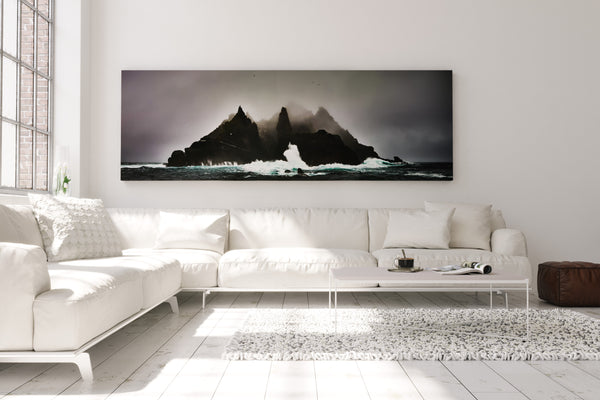
Photograph from the water. If you end up on a cruise around the islands rather than a landing, use the time well. The views of both Skellig Michael and the Small Skellig from the water are often more dramatic than anything you'd get from the top of the steps. The gannet colony on the Small Skellig is mesmerising from close up.
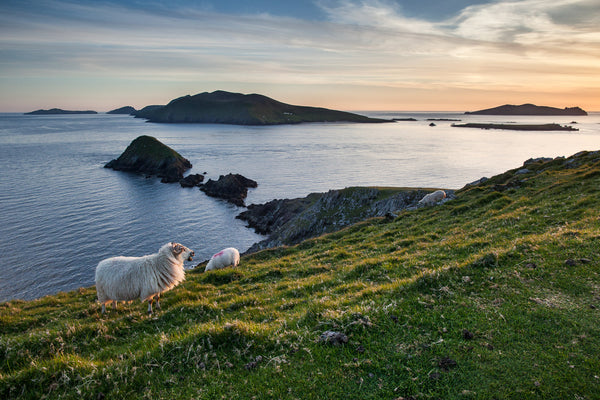
Photograph from the mainland. Some of my most successful Skellig images have been made from the Kerry coast. The Telegraph Field on Valentia Island, the Glen south of Ballinskelligs, and Bray Head on Valentia all offer exceptional views of the islands - and you can work at sunrise, sunset, and under the stars with no access restrictions at all.

The Images That Stay
After over a decade of returning to these islands, the photographs I value most aren't the obvious wide-angle dramatic shots. They're the quieter images - the ones that reward a second look. The monastery in pre-dawn twilight with the last stars fading. The Small Skellig emerging from fog. The gentle light on the stone of the oratory just after sunrise.
I feel my work here is just scratching the surface. Every visit shows me something I haven't seen before, and every photograph is part of an ongoing project that I don't expect to finish. That's what keeps me going back.
Leave a comment