




There was no secret about it, despite what some accounts suggest. Everyone in south Kerry and west Kerry knew what was coming - a Star Wars production was arriving, and the excitement was considerable. Big Hollywood comes to Portmagee. It was quite the event.

The Force Awakens
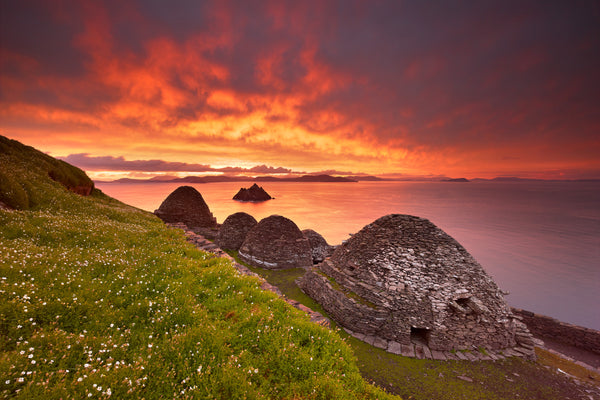
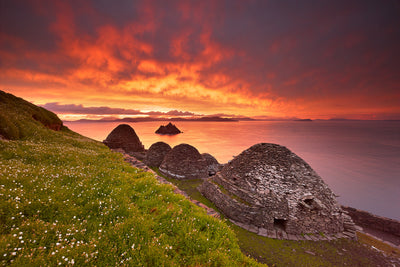
The Force Awakens filmed on Skellig Michael in 2014. The entire production for the Skellig scenes was based out of Portmagee, and the island itself served as the location for the final scene - the sequence where Rey climbs the steps and finds Luke Skywalker standing on Christ's Saddle, the ridge between the island's two peaks. The monastery is shown briefly as Rey passes it on her way up, but no characters appear in it - it's a fleeting glimpse of the beehive huts as she climbs past. There's a nice irony in this: the monastery sits higher than Christ's Saddle, so the dramatic reveal at the 'top' of the island was actually filmed lower down than the spot Rey walks through to get there. The scene lasts about a minute on screen, but it put the Skelligs in front of a global audience in a way that nothing else ever had.
The Last Jedi
The Last Jedi was a much bigger operation. Where The Force Awakens confined itself to Portmagee and the islands, the sequel covered nearly the entire west coast of Ireland. Filming locations stretched from the Dingle peninsula to Malin Head in Donegal, with sites in Clare and Cork as well.
Crucially, permission to film within the monastery itself was denied for The Last Jedi. There was significant pressure from heritage and conservation groups - understandably so, given the site's status as a UNESCO World Heritage Site and its significance as an early Christian holy place. So the production built a replica set of the beehive huts on Ceann Sibéal, a headland near Ballyferriter on the Dingle peninsula. Eight replica huts were constructed there to resemble the Skellig monastery, and this is where the scenes of Rey training with Luke were actually filmed. The set was dismantled after filming, and the headland has returned to its normal state of wind-blasted sheep pasture.
The actual monastery on Skellig Michael never appears in The Last Jedi - it's all the Ceann Sibéal set. So if you visit the Skelligs expecting to recognise the interiors from the film, you'll be looking at the real thing rather than the film version of it, which is arguably a better deal.
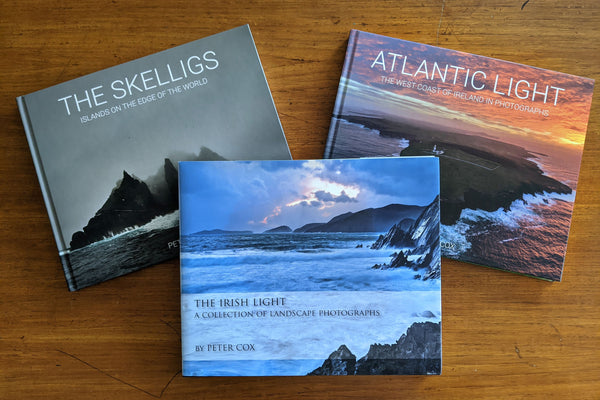
I'm told that director Rian Johnson has at least one copy of my book Atlantic Light in his collection - given as a gift during the production. I'd like to think it informed some of the visual language of the film, but I suspect the island did most of the talking on its own.
Puffins and Porgs
The famous native puffins presented a problem for the crew. The island is a Special Protection Area, and the puffins are a protected species - they couldn't be moved, and they wouldn't stay out of shot. The production's solution was to digitally replace them with Porgs, the small wide-eyed creatures that became one of the more divisive elements of The Last Jedi. Love them or hate them, they exist because the island's real residents kept wandering into frame and nobody was allowed to do anything about it. I suspect the puffins were fairly indifferent to the whole business.
What's Real on Screen
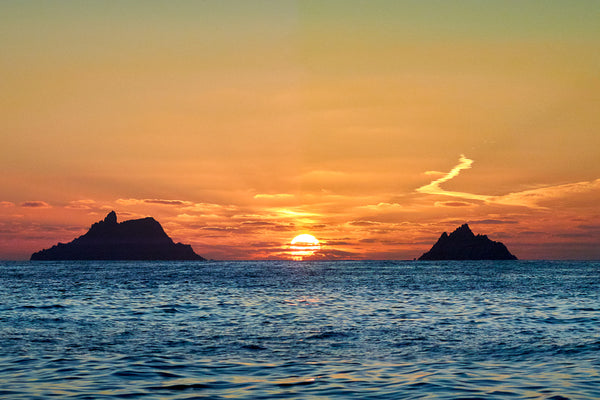
What's interesting, from a local perspective, is that the production team added various fictional elements around the island digitally - extra rock formations, additional stone structures, that sort of thing - but the Skelligs themselves were left more or less untouched. They didn't have to do much to make it look otherworldly. The monastery steps that Rey climbs in The Force Awakens are the same steps that monks climbed every day for centuries. The landscape shots of the island rising from the Atlantic are the real thing. The production designers recognised what anyone who's been there already knows - the place doesn't need embellishment.
The Tourism Effect
Since the films, international interest in the Skelligs has skyrocketed. The island was already a UNESCO World Heritage Site and a well-known destination for those interested in early Christian history, but Star Wars put it on a completely different map. Demand for boat tours has far outstripped what the island can handle.
The irony isn't lost on anyone locally. The island that served as the most remote outpost in a fictional galaxy is now struggling to accommodate the attention that role brought. Access remains strictly limited to about 180 visitors per day, weather permitting, and even those numbers are a source of ongoing debate about conservation and sustainability.

Should You Visit Because of Star Wars?
If Star Wars is what first put the Skelligs on your radar, that's a perfectly good reason to go. But I'd encourage you to look beyond the films once you get there. The real history of the island is every bit as compelling as the fictional one - and considerably stranger. A small group of monks choosing to live on this rock for six hundred years, building a monastery on man-made terraces with no mortar and no fresh water, is a story that doesn't need a Hollywood backdrop to be remarkable.
The monastery steps that Rey climbs are the same steps that monks climbed every day for centuries. The beehive huts where Luke Skywalker broods in the Ceann Sibéal replica are based on the same huts where twelve monks and an abbot lived, prayed, and endured Atlantic storms. The real ones are better. That's the story I find myself returning to, long after the credits have rolled.
Leave a comment