




Skellig Michael: The Definitive Guide to Ireland's Most Dramatic Islands
I've long had a fascination with remote places, so it's surprising to me that I wasn't aware of the Skelligs until I was in my 20s. I recall driving into Dingle with some friends, and seeing these jagged islands on the horizon - my interest was piqued, so I found a map and figured out what they were. From then on, I've been fairly obsessed with them. It would be years before I first set foot on Skellig Michael, and I still remember the excitement and anticipation as the boat pulled closer to it.
I've travelled all over the world. I've photographed in Greenland, Antarctica, and Iceland. The Skelligs are probably my favourite place to photograph - a place that's very special to me personally, but also photographically. For the last decade and more, I've been returning to them in all seasons and all weathers, building a body of work that I hope captures something of what makes these islands so extraordinary.
This guide draws on those years of experience. It's a personal account of a place I know intimately - written for anyone planning a visit, anyone who's been and wants to understand more, or anyone who simply wants to know what all the fuss is about.
What Are the Skellig Islands?
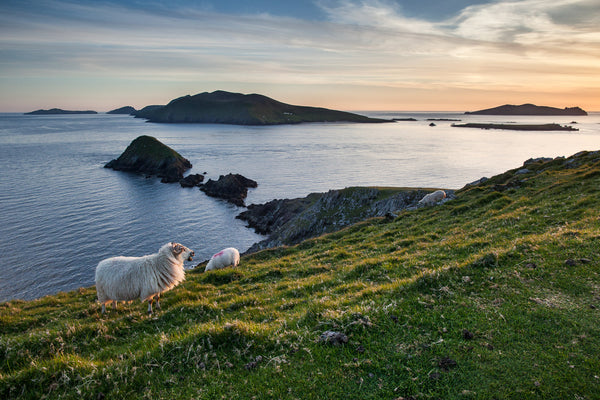
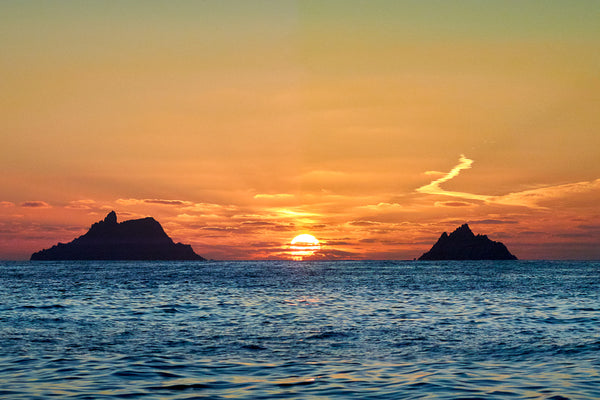
The Skelligs are a pair of rocky, wild islands about 12 kilometres off the coast of Kerry in the south-west of Ireland. The name is an anglicisation of the Irish word "Sceilg", generally translated as 'a splinter of rock'. They consist of Skellig Michael (Sceilg Mhichíl in Irish), the larger of the two, and the Small Skellig (an Sceilg Bheag). A third rock, Lemon Rock, sits closest to the mainland.
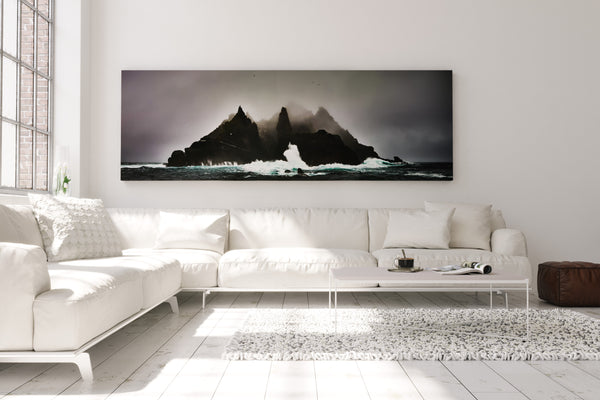
The islands are the eroded remains of an extension of the Kerry Mountains - from certain parts of the mainland, the three rocks form a nearly perfect line on the horizon, a geological accident that only adds to their drama. Skellig Michael has two precipitous peaks, giving it the appearance of a pair of horns rising from the ocean. It houses two lighthouses (one decommissioned), a 6th century monastery, and a hermitage from the same era.
Skellig Michael is a UNESCO World Heritage Site. The Small Skellig is one of the largest gannet colonies in the world, home to tens of thousands of breeding pairs. Neither island has any permanent inhabitants today, though Skellig Michael receives limited numbers of visitors during the summer months.
The Monastery: A Feat of Human Audacity

What makes Skellig Michael so fascinating is its severe natural beauty, and the grit and determination of those early monks to carve out an existence on what was the very edge of the known world. The monastery was founded around the 6th century and was in continuous use until about the 12th century, although these dates aren't exactly known - there are very sparse written records mentioning it, and no records at all from the island itself. It's a source of real frustration that there are no surviving writings by any Skellig monk. We can only guess at what daily life was like.
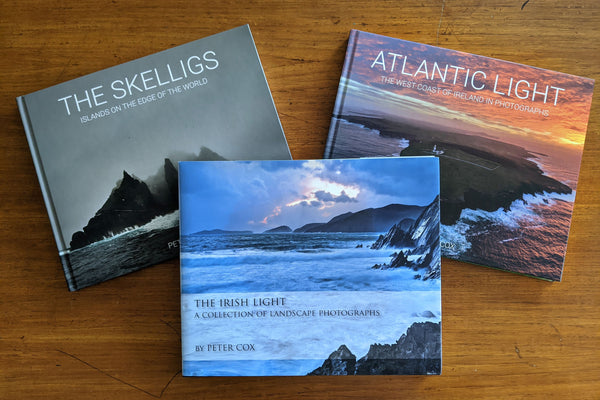
The monks were ascetics, following in the footsteps of St. Anthony of Egypt who lived around the 3rd century. This branch of monasticism strove to be closer to God by living in harsh, isolated conditions. St. Anthony spent much time in the Egyptian desert, and the Skellig monks chose Skellig Michael as the closest analogue to those conditions in Ireland. For them, the subtitle of my book rings true.
These were 'islands on the edge of the world'. There was nothing beyond that. Here be dragons.
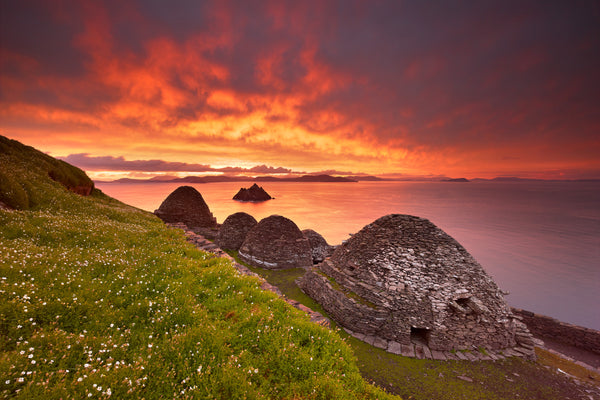
The island has almost no flat space, so terraces with enormous retaining walls were needed to produce enough ground to build on - from the sea this gives the monastery a fortress-like appearance. There's no fresh water on the island, so the monks gathered rainwater in channels and grooves in the rock and directed it into cisterns beneath the monastery. The 'beehive' huts are drystone construction - made without mortar - and the roof is constructed by setting each course of stone slightly inward from the one beneath, working up in gradually smaller circles until the roof is closed. Each course is canted slightly outward to encourage rainwater to drain away, with the result that they've stayed watertight for centuries.
It's probable that there were twelve monks and an abbot in the monastery at any one time, sharing these very Spartan accommodations. Weather conditions, especially in winter, would have been stormy and unforgiving. Damp and cold would have been constant companions.
The OPW took the monastic ruins into state guardianship in 1880 and has been working on their conservation ever since. The current phase of work began in 1978 when a retaining wall in the monastery collapsed and needed urgent repair. Major conservation works commenced in 1986, carried out in tandem with archaeological excavations that continued almost every season until 2010. The work focused on stabilising and consolidating the terraces and their retaining walls - critical infrastructure without which the entire monastery would eventually have slid into the sea. While the beehive huts look ancient, and their form is original, they've been subject to extensive restoration work over the decades.
The few mentions of the monastery that do exist in the historical record point to Skellig as being an important religious site. One tells us: "Scelec was raided by heathens and Etgal was carried away, and he perished with hunger because of them." The heathens would have been Vikings. Etgal would have been the abbot, likely taken for ransom as monasteries were often rich places. It seems they weren't satisfied with the proposed payment.
For the full story of the monastery - the archaeology, the human remains, and what daily life was like on the edge of the world - see The Monks of Skellig Michael.
The South Peak Hermitage
And if the relative comfort of the monastery itself was too luxurious, there's the South Peak. It's probably my favourite geological feature of the island - a fin of rock rising 218 metres from the ocean, augmented by the remarkable construction of a hermitage on its terraces. Although earlier observers had noted what seemed to be artificial ledges and stairways on the pilgrimage route to the summit, it wasn't until 1990 that researchers removed the covering vegetation and confirmed that the South Peak was the site of a remote hermitage, likely dating from the 9th century. They identified three distinct terraces: the Garden Terrace, the Oratory Terrace, and the Outer Terrace.

The Oratory Terrace is the most important of the three - it holds a corbelled oratory measuring roughly 2.3 by 2 metres, with the remains of an altar against the east wall. Beside it, two small interconnected basins hold rainwater, channelled down from the near-vertical rock faces above. A vital resource for a hermit in this inhospitable place. The monks had even cut rock-cut steps up through a cleft in the rock known as the Needle's Eye to reach these terraces - a passage that would test anyone's head for heights.
In centuries past, pilgrims completing the stations of the cross would shuffle out along the knife-edge summit ridge with nothing but empty air on either side, to reach a vertical slab inscribed with a cross. Upon kissing this, the ordeal was complete. Sadly, this slab was lost in the mid-1970s. Divers searched Blue Cove directly underneath, but no trace was ever found. Most likely centuries of wind and rain had taken their toll.
The Lighthouses: Another Story of Endurance

The monks weren't the only ones to make a life on this rock. Both Skellig lighthouses were designed by Inspector George Halpin, built simultaneously, and completed in 1826. The lighthouse builders used the monastic cells as their living quarters while the work was under way, a practical arrangement that must have been a strange experience, bedding down in a structure built by monks a thousand years earlier.
The Upper Lighthouse was abandoned in 1870 when the light on Inis Tiaracht to the north was lit, and it remains as a ruin today. The Lower Lighthouse continued operating. Originally fuelled by paraffin vapour, it was converted to electric in 1967, surprisingly late in the 20th century.
In the early days, the keepers and their families lived full-time on the island. It was a life of severe hardship, and evidence of it is left in the grave of two young children - the Callaghan brothers, aged two and four, who died in the winter of 1868-69 - in the monastery itself. Harsh as it was, you can also imagine a family sitting on the terraces in the twilight, enjoying the peace and serenity of this remarkable place.
In 1969, helicopter reliefs were started as a trial, and there was supposed to be a period of analysis afterwards. It proved so popular that it was rolled out immediately - the alternative, one suspects, would have been a full-on uprising of lightkeepers! The lighthouse was automated in April 1987, and the keepers left for good.
In July 2012, I was on the island as the Lower Lighthouse was further reduced to a flashing LED beacon. The welcoming glow of the domestic light from the keepers' accommodation windows was about to become a thing of the past. A little more of the island's history sliding away. The Lower Lighthouse has since been passed to the OPW, and refurbishment works are ongoing to make it available as accommodation for conservation staff, guides, and researchers. The walk from the Lower to the Upper Lighthouse is one of the highlights of Skellig that I hope will one day be open to the public - the current restoration work on the path between the two lighthouses may lead to exactly that. The views are spectacular, and the engineering of the lighthouse builders is every bit as worthy of admiration as that of the monastery itself.
Star Wars and the Skelligs
The appearance of the Skelligs at the end of Star Wars: The Force Awakens caught a lot of people's attention. What's interesting, from a local perspective, is that they did a lot of digital work adding little islands around it, but the Skelligs themselves were more or less untouched - they didn't have to do much to make it look otherworldly. The famous native puffins were morphed into the specially created Porgs, but when it came to the islands themselves, they were shown in their original glory.
Since the release of The Force Awakens and its successor The Last Jedi, international interest in the islands has skyrocketed. The irony isn't lost on anyone locally that the increased demand to visit far exceeds what the island can handle - due to the limited daily capacity and the unreliable Irish weather, many more people want to visit than can actually do so. It's worth noting, incidentally, that even a production with the resources of Star Wars wasn't permitted to overnight on the island. Access is that strictly controlled.
For more on the filming, the locations, and how the puffins became Porgs, see Skellig Michael & Star Wars.
How to Visit Skellig Michael

Access to Skellig Michael is strictly limited to about 180 people per day during the summer months - typically mid-May through September, weather permitting. There are 15 boats licensed by the OPW to carry 12 passengers each, and they depart mainly from Portmagee, with a couple operating from Ballinskelligs and Derrynane. Booking well in advance is essential - trips fill up quickly, especially in July and August. That said, there are often cancellations on the day, so if you couldn't get a booking but you're in the area, it's worth showing up at the marina early and asking. You might get lucky.
Even with a booking, weather cancellations are common - the most recent season had about a 65% success rate for landings. The Atlantic crossing takes about 45 minutes to an hour each way, and conditions can be rough. If you're prone to seasickness, come prepared.
The landing itself can be an adventure. The pier at the base of the rock can be slippery, and getting ashore from a bobbing boat requires decisiveness and reasonable agility. The crews are experienced and helpful - they've been doing this for decades and they're very good at getting people safely on and off.
Once on the island, the Lighthouse Road extends from the pier to the base of the south steps - it's an easy enough walk, and for those who'd rather not tackle the climb to the monastery, there's still plenty to see along it without subjecting yourself to the full ordeal. For those who do make the climb, it's 618 uneven medieval steps to the top. The steps can be slippery when wet, and there are no handrails on much of the route. I've been on the island many times in high wind, where people had to climb on their hands and knees. Once you reach the enclosure, however, the wind drops away to a gentle breeze due to the shelter offered by the peak itself. It's worth every step!
A few practical tips from someone who's made the crossing many times: wear layers (the weather can change dramatically in an hour), bring a waterproof jacket, wear sturdy shoes with good grip, and carry water and lunch in a rucksack so your hands are free for climbing. There are no facilities on the island. No toilets, no shelter, no shop. You're on a rock in the Atlantic, and you need to be prepared for that!
If the weather prevents a landing, many boat operators offer a cruise around both islands instead. This is well worth doing - you'll get close-up views of the gannet colony on the Small Skellig, which is extraordinary in its own right, and dramatic views of Skellig Michael from the water. One word of caution, though: if the water's too rough to land, it's not going to be a comfortable cruise either. If you tend to go green in the bathtub, you might want to think twice.
For the complete practical guide - boats, booking, what to bring, and what to expect on the day - see How to Visit Skellig Michael.
The Wildlife: Puffins, Gannets, and More
Being a landscape photographer, I'm mainly drawn to that side of the islands, but it's impossible to ignore Skellig's most charismatic resident - the Atlantic Puffin. These wonderful birds appear in April and are gone around August. They spend the rest of the year in the North Atlantic, not touching ground until they return again the following year. They nest in burrows on the island and spend the day fishing in the waters around. Standing on the steps to the monastery as they flit around your head is a memorable experience!


The Small Skellig is home to one of the largest gannet colonies in the world. From certain angles, the island appears to be covered in snow - that's thousands upon thousands of gannets on their nests. Sadly, in recent years the gannets are bringing more and more plastic back to the island instead of their traditional nesting material of seaweed and grasses. It's a visible and sobering reminder of the impact we're having on the oceans.
You'll also encounter Manx shearwaters, storm petrels, fulmars, kittiwakes, guillemots, and razorbills. Grey seals are regular visitors to the coves around both islands. The waters around the Skelligs are rich with marine life - basking sharks, dolphins, and even whales have been spotted on the boat crossing.
Photographing the Skelligs
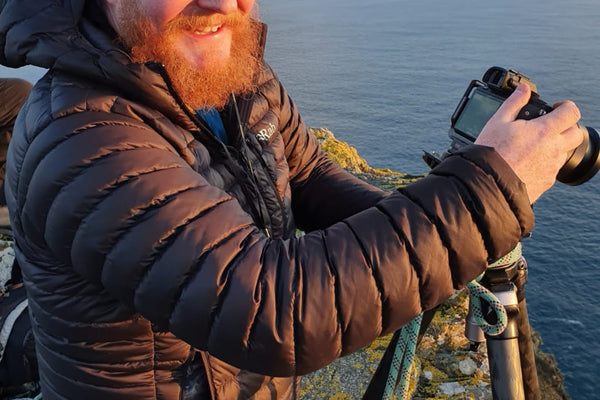
So much in photography depends on going out in marginal conditions. You'll either come back with something spectacular or you'll come back empty-handed - there's rarely a middle ground on those days. I've lost count of how many trips I've made to the Skelligs, and every one has taught me something. Returning again and again has allowed me to develop an intuitive sense of their rhythms. I know how the light falls on the monastery at dawn, I know how the gannets of the Small Skellig lift off in great bursts at particular wind speeds, and I know when the mist is going to roll in from the west before I can see it.
For most visitors, the photography window is limited to mid-day in summer, which is unfortunately when the light is at its worst. The images that define these islands - the dramatic sunrises, the moody storms, the sky above the beehive huts - all require access outside those hours. I've been fortunate enough to gain that access through the OPW and the Commissioners of Irish Lights, and it's given me the opportunity to photograph the islands in conditions that very few people witness. Even the Star Wars production team wasn't permitted to overnight on the island, so these images really are from a rare vantage point.
The nocturne photographs were logistically the most difficult to make, and they're unique. The Iveragh peninsula is home to the Kerry International Dark Sky Reserve - the first Gold Tier reserve in the Northern Hemisphere, and one of only four in the world. Being out there after dark, seeing the sky very much as the monks would have seen it, was quite something. I was fortunate in that the sky was very clear on the one occasion I stayed over. Genuinely one of the best sessions of photography I've ever had.

For anyone visiting with a camera, my main advice is this: don't try to capture everything. The sheer presence of the place - especially Skellig Michael with its dry-stone oratories and gravity-defying stairs - is overwhelming. Resist the urge to photograph it all with wide angles and dramatic light. Focus on something. A curve of dry-stone wall. The play of shadow across a beehive hut. A puffin preening in the rain. Those are the images you'll come back to years later.
And a practical note: cameras these days, even mobile phones, are at the point where you can get very high-quality images. A mobile phone image thoughtfully composed will be far better than a careless photograph made with a state-of-the-art camera.
For more on the logistics of photographing in one of the most challenging locations in Ireland - including the nocturne sessions - see Photographing Skellig Michael.
The Skelligs in Winter
Most people see the Skelligs in summer sunshine - if they see them at all. But I find the winter months some of the most productive for photography. The light is dramatic, the storms are fierce, and the islands take on a completely different character.
During winter storms, the entire Small Skellig has been known to be overtopped by huge waves. The seas around the islands can be savage, and there's a reason the lighthouses were built here - these waters claimed ships and lives for centuries.
One of my favourite images was made from the Telegraph Field on Valentia Island - the spot where the very first transatlantic cable made landfall. Looking west to the Skelligs against the backdrop of the winter sky, with the constellation of Orion hanging directly over Skellig Michael. That kind of photograph is much harder to get in the busy summer months.

A change in climate around the 13th century that probably brought stormier conditions during winter, combined with a shift in the Irish Church towards a more centralised structure, spelled the end of Skellig as a permanent establishment. Standing on the mainland watching a winter storm hammer the islands, you understand why.
Why These Islands Stay With You
I love wild and remote and inaccessible places, and the Skelligs are certainly all of those things. It's a combination of the physical beauty - because they are just so dramatic and jagged - and the human side of it. The monks, the lighthouse builders, the keepers and their families. Each layer of human endeavour on this rock adds to the story.
There are places that make an impression the first time you see them, and then there are places that never let you go. For me, the Skelligs are the latter. I feel my work here is just scratching the surface of what's there. I look forward to continuing to work with them.
I've been photographing the Skelligs for over a decade now and the collection keeps growing. If any of the images in the Skelligs collection resonate with you, I'd be delighted to help you choose the right print for your space. And if you want the full story of how these photographs were made, have a look at the book.
Enjoyed this?
Get 12 stories behind Peter's favourite photographs as a free PDF, plus new letters as they're written.
No spam, ever. Unsubscribe anytime.


Leave a comment