




The Fastnet Lighthouse: Inside Ireland's Teardrop
The Fastnet Rock sits about six and a half kilometres off Cape Clear Island, at the very southwestern tip of Ireland. For thousands of emigrants leaving Cork Harbour in the nineteenth and twentieth centuries it was the last piece of Ireland they saw, and that's how it came by the name Ireland's Teardrop.
I've been photographing it for the best part of twenty years, from Mizen Head, from Cape Clear, from the hills above Schull, and from the air. But I've also been lucky enough to spend six or seven nights out on the rock itself, across a number of visits over the years. My rough reckoning is that fewer than a hundred people who weren't lightkeepers have ever slept in that tower, and that number isn't going to grow quickly. This is what I've seen out there.
Why the tower stands where it does

This is the photograph I point people to when they ask why the tower stands where it does, because it answers the question without anybody needing to say a word. The rock rises up behind, and the lighthouse is right down at the seaward edge, low, at sea level, on the side that faces the prevailing weather. That looks wrong at first glance. You'd think you'd put a lighthouse on the highest point you had, both for the range of the light and to keep it clear of the water.
That's exactly what was done the first time. The tower that stood here before this one was cast iron, finished in 1854, and it was built up on top of the rock. What was learned in the decades that followed, as understanding of wave energy improved, is that a tower on the summit is in the worst possible place. A wave coming in off the open Atlantic runs at the rock with nothing to interrupt it, and by the time it reaches a structure standing clear on the high ground it's arriving at full force, undiminished, over and over again through every winter.
So the granite tower was put in the opposite place: low down, at the water, on the exposed side, with a base that flares outward as it goes down. The wave energy is broken up and dissipated across that flared base before the water ever reaches the full height of the walls. The tower behaves something like the bow of a ship, splitting the incoming water and shedding it away to either side rather than standing square in front of it, and the result is that the structure has far less to withstand than its predecessor did in what looked like the safer position. It's one of my favourite pieces of Victorian problem-solving anywhere on this coast, and it's the thing I most want people to see in that aerial frame.
The rest of the history is just as good. It was designed by William Douglass and built under James Kavanagh, who lived out on the rock almost continuously from 1896 and personally set every single one of the 2,047 blocks of Cornish granite that make it up. Not supervised the setting of them, set them. Those blocks run from about one and three quarter tons up to three tons apiece, 4,300 tons of stone in total, and they don't merely sit on top of one another. Each one locks into its neighbours with dovetail joggles, a system worked out by Douglass's father Nicholas on the Guernsey light, so the whole tower is keyed together into a single mass rather than a stack of courses. A steamship called the Ierne was built specifically to carry the stone out to the rock, which gives you some idea of the scale of the undertaking.
Kavanagh laid the eighty-ninth and final course in June 1903 and was taken ill immediately afterwards, having given seven years of his life to it. The light came into service in June 1904, at a cost of close to ninety thousand pounds. The masonry tower stands 146 feet, with the light 159 feet above high water.
And even with all of that thought given to where it sits and how it sheds the sea, it isn't unusual in winter storms for green water, solid unbroken water rather than spray, to go clean over the top of the whole thing. When you're standing out there on a calm day with the swell barely moving, that's almost impossible to hold in your head. Then you look again at the flare of the base and the way it's turned to face the weather, and it makes complete sense that they built it exactly like that.
The way in


Fáilte Isteach means welcome in, and that's the door standing open at the base of the tower with the light spilling out of it, the cloud moving overhead and the lantern lit at the top. It's the only way in or out of the building. The name came from Neilly O'Reilly, the attendant on the rock, who suggested it while I was working, and it was so fitting I used it on the spot.
Up close the door is worth a proper look. It's gunmetal, a copper alloy, which is why it's gone that soft green, the same patina you see on any copper roof that's been up long enough. The offshore rock lights used gunmetal for doors and window frames as a matter of course, because it stands up to constant salt in a way steel simply doesn't out there.
Then there are the locks on the outside of it, and they look wrong. Jury-rigged, bolted on, out of keeping with everything else about a building where the stones were cut to lock into one another. There's a very good reason for that. When the tower was built, nobody involved imagined a day when it would be empty. Keepers were going to be in it, always, so the door was designed to be locked from the inside and that was the end of the matter. Automation wasn't foreseen, because the concept barely existed. So when the light was automated in 1989 and the keepers came off the rock for the last time, somebody had to design and fit an external locking mechanism onto a door that had never been meant to have one. What you're looking at is that retrofit, sitting on eighty-five years of Edwardian engineering.
The precision elsewhere in the building is the other side of the same story. The window shutters are metal closing onto metal flanges, and there's no gasket, no rubber, no seal of any kind anywhere in them. They're watertight regardless, because the two faces are machined to a tolerance fine enough that if you catch a single sheet of paper between them, the lock won't engage. That was the standard being worked to on a rock in the open Atlantic, by men landing stone off a boat.
Over the edge


I've put those two together deliberately. The first one is what it actually feels like to be up there, my own boots over the edge and the water a long way down. The second is the photograph I made from the same place once I'd stopped thinking about the drop: the flared curve of the granite falling away, the old structures on the rock, and the white water, with nothing human in it at all. One is the experience and the other is the picture, and I don't think either of them tells you the whole thing on its own.
The lantern


These two go together as well, and for the same reason. The first is made from the air, in close at sunrise, looking at the lit lantern from outside. If you look through the glazing in that frame you can see a ladder going up inside the lantern room. The second was made from the top of that ladder, looking down. Side by side they tell you exactly where I was standing for the second one, which is something the interior photograph can't tell you by itself.
The main light was a first-order Fresnel lens, and there's no way to prepare somebody for the size of it. Two storeys tall, somewhere around ten tons, built from concentric rings of glass ground to throw the light out flat across the water. Ten tons of glass and brass, and it sat in a bath of mercury.
That mercury bearing is the part I still find hard to get over. The whole assembly floated on liquid metal, so there was next to no friction anywhere in the system, and the practical consequence is this: if the lens was stopped, one person could set ten tons of it moving again with the pressure of a little finger. I've done it. You put a finger against it, push gently, and this enormous thing begins to turn, slowly and silently, and keeps going. It's one of those moments where your understanding of how heavy things behave gets quietly rearranged.
All of that is history now. A few years back the mercury was drained out of the bath and the lens was shrouded, because a new LED beacon was fitted above it. The LED rotates rather than blinking on and off, so the Fastnet still has something of its old character out on the water, a light that sweeps rather than flashes. But it doesn't have the presence of the original. There's no real comparison between a solid-state unit doing its job efficiently and two storeys of glass turning on mercury.
What the looking-down photograph shows is a very narrow platform at the top of that ladder, big enough for one person and no more, with no rail around it at all. The only thing to hold is a single stanchion, a pole with a rounded top, and you take hold of it as you come off the ladder and get your feet onto the platform. There's a pair of leather gloves laid out neatly, and they aren't a stray detail. Up there you'll find an active bulb and a standby, and the system was built so that if the active bulb failed a motor swung the standby into the focal plane automatically, with nobody needing to be there. The gloves were for the attendant handling those bulbs: partly because a bulb being changed could still be hot, and partly so no fingerprint grease got onto the glass, which burns on and shortens the life of the bulb.
The thing I wasn't ready for was what it feels like to stand on that platform while the lantern is running. The lens turns continuously, so nothing in your field of view holds still. The panels sweep past, the light goes round, and the whole visual world is in motion while you're standing on a small square of steel with one pole to hold. Your brain resolves it the wrong way round, and you become convinced that you're the thing spinning and the lantern is standing still.
A walk through the tower
If you'd like to see the whole building rather than pieces of it, I made this walkthrough on one of the visits. It starts at the oil store under the helipad and goes all the way up through the tower to the lantern room, so you get the sequence of it, and some sense of how far it is from bottom to top.
The rooms


The curved stairwell spirals up through the tower and every level served a purpose. There were six keepers on the Fastnet, four out on the rock at any time and two ashore. Each man did four weeks on and two weeks off, and the reliefs came twice a month taking two men at a time, so the changeover was always staggered and there were never four new faces arriving at once.
People assume the quarters are a preserved relic, and they aren't. The tower is still stayed in. It has to be maintained, and when maintenance work is being done a crew goes out for two or three weeks at a time, a few times a year. So the rooms are kept up because they're still lived in, just not continuously. The mahogany, the bunks and the mess room are in use, not on display.
The column running up through the centre of every floor is the reason the light ever turned. Before the tower was electrified the rotation was governed by a clockwork mechanism, and the mechanism was driven by a weight. The column is hollow, and the weight hung inside it on a chain. A keeper hauled it up to the top, gravity took it slowly back down, and that descent is what drove the lantern round. When it reached the bottom somebody hauled it up again. The whole light, turning all night, powered by a falling weight in a hollow column.


The kitchen sits just below the lantern room and it's the social hub of the place. It's where people gather, eat, relax, watch television, read a book. There's a great deal of machinery in the tower and a great many stairs, and there are two levels of bunk rooms, but the bunks are for sleeping in. The kitchen is the room where everybody gathers.
At the base of the old tower there's a pane of glass where names have been scratched into it over the years. "J. Kavanagh 1969" is clearly legible. I don't know who he was, and I've no reason to connect him to the James Kavanagh who built the place, who had been dead a long time by then. But whoever he was, he worked here. He'd have been a keeper, or a fitter out on a job. 1969 is the year the oil light was replaced with electricity out here, which would have brought men and work with it.
In 1989 the Fastnet went fully automatic and the last keepers left for good.
Staying out there
On my first visit Neilly gave me the one rule of the place: you never go up or down the tower without carrying something. Whenever anyone is arriving or leaving there's always gear, food, water, tools or equipment that needs to move between the door and the rooms above, and there are a very great many steps between the two. Nobody makes a wasted journey on the Fastnet.

The part I'd struggle to convey properly is lying in a bunk in that tower at night. You can hear the wind and you can hear the water outside the walls, and the sound is only half of it, because what really gets you is knowing precisely where you are while you're listening to it. There's a granite wall a few feet away and beyond it the Atlantic, and nothing else for a long way in any direction. You know exactly how isolated it is and exactly how exposed, and you're warm and dry inside walls that a man set by hand, one three-ton block at a time, more than a century ago.
From the sea

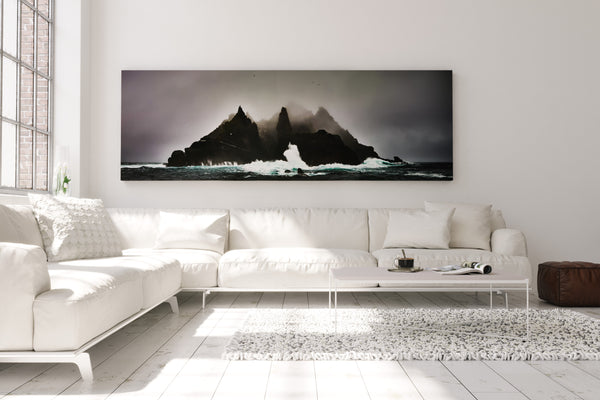
The name comes from the Old Norse Hvasstan-eit, sharp-tooth island, and you understand why the moment you see the water hit it. The photograph above is a wave coming into that jagged base and going straight up it. The tower looks elegant enough against a calm sky, and then you see what it actually stands in.
Before dawn the rock is only a dark shape on the horizon, and then the first light arrives and the granite turns gold. There are a couple of dawn photographs in the collection and both were made in those few minutes, when the colour changes fast and you're working quickly to keep up with it.
I've been photographing this rock for the best part of twenty years and it still catches me out on certain mornings, when the light does something I haven't seen before.
The prints
All of these are available as prints, and you can see the Fastnet work alongside the rest of the Cork collection. If you'd like a hand choosing an image, or working out what size suits a particular wall, get in touch through the contact page and I'll help you sort it out.
They also hang in my gallery in Glengarriff, on the main street next to the pharmacy, a minute's walk from the Blue Pool, if you happen to be out that way.
Cheers,
Peter
Enjoyed this?
Get 12 stories behind Peter's favourite photographs as a free PDF, plus new letters as they're written.
No spam, ever. Unsubscribe anytime.


Leave a comment